PREP
You've got your vision and your core team...now what?

I’m back! You finished pre-production, and production is getting wildly close. First of all? Fun! Let’s get started.
The difference between pre-pro and prep?? Mostly just time. Pre-pro is for the larger sweeping creative conversations that will inform how you prep! It’s also for the production items that can take a little more time than you would like, insurance, and music. I don’t think I mentioned music in the last one, so I’ll do it here. If you want a certain song, you’ll need to obtain the rights to it. If you want to keep it in the short forever, the licensing needs to be in perpetuity all media worldwide (that will be expensive), OR you’ll need to obtain the festival rights (less expensive). HOT TIP: Stay away from music you have to license, as it can literally take six months or more to obtain this, and festivals will want to know that you have the proper rights for the contents of your short (music, etc). Hire a composer. Do something fun and original. I’ve done it both ways and recommend the latter.
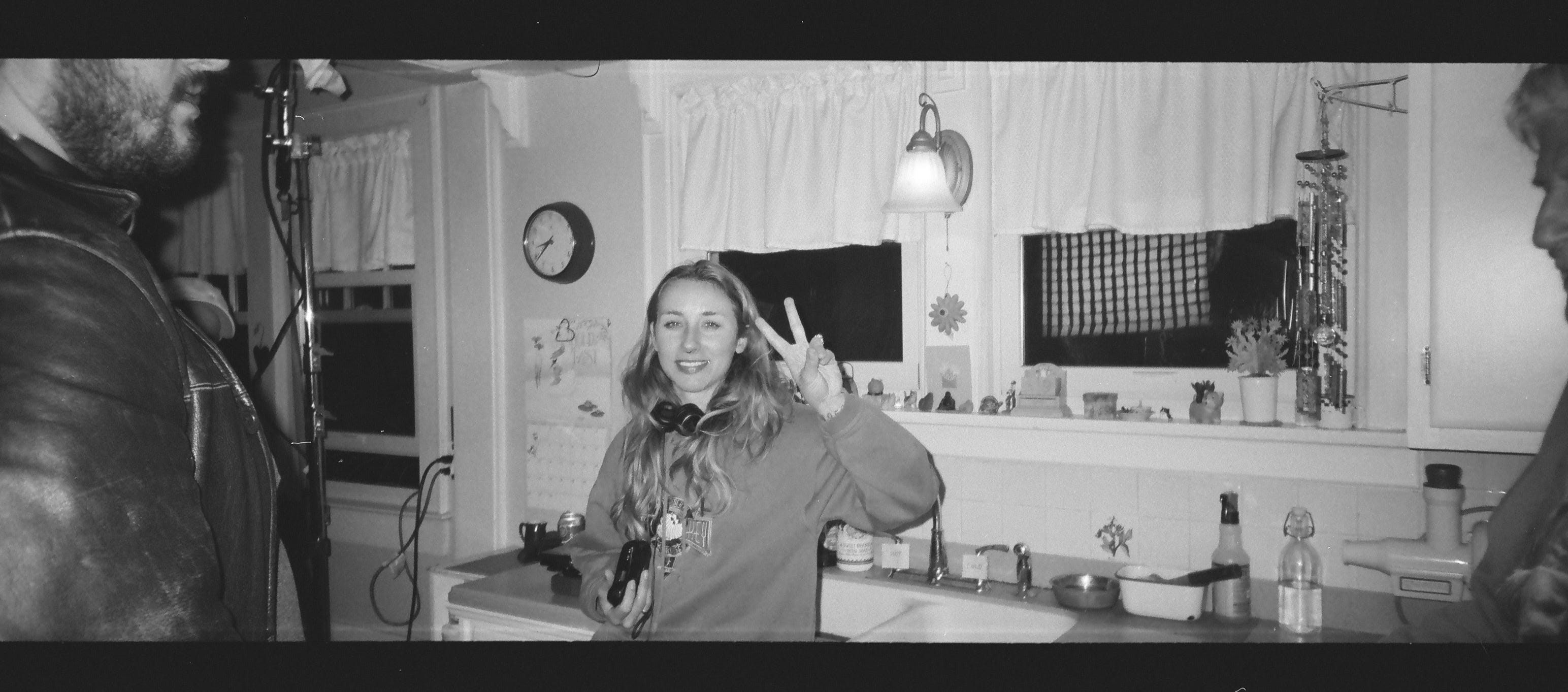
Me on the set of Wooly Bully wearing a sweatshirt I got from our Costume Designer, Nina Attal. I wore it the whole shoot… it became a security blanket.
HIRING
First things first, you need to lock in your crew! Your core people are in place, and now it’s time to fold everyone else in. Mostly, I defer to department heads to crew up with their people first, and then I can fill in the gaps with other people after the fact.
As I mentioned before, short films are all hands on deck, so depending on the scope of your film and what your story requires, this will look different for everyone. But let’s pretend that we’re shooting a 15-page script with no heavy VFX, three principals, and two locations.
CAMERA - More than likely, your cinematographer is also one of your camera operators, OR your only operator. I’ll say that for the most part, defer to your DP’s comfort with crew, etc (always), but in general, I find DP plus 1st AC, 2nd AC, and DIT is plenty. Many people won’t do a DIT, but I think it’s worth the expense to see what you’re getting in real time. They can also act as a second set of hands for the camera team if needed. This is, of course, assuming you have one camera body for the shoot. I’ve done it both ways. If you have the cash, I’d recommend two camera bodies. 1) It helps to have one camera split off and grab B-roll or shots that don’t require actors. They can also be helpful if you have a scene with lots of actors and you’re crunched for time. 2) God forbid something happens with the A camera body, you have a second. This actually happened to me on my last shoot and I did not have an extra camera body and it almost screwed us. Thank you, Kim Herman, for saving my life.
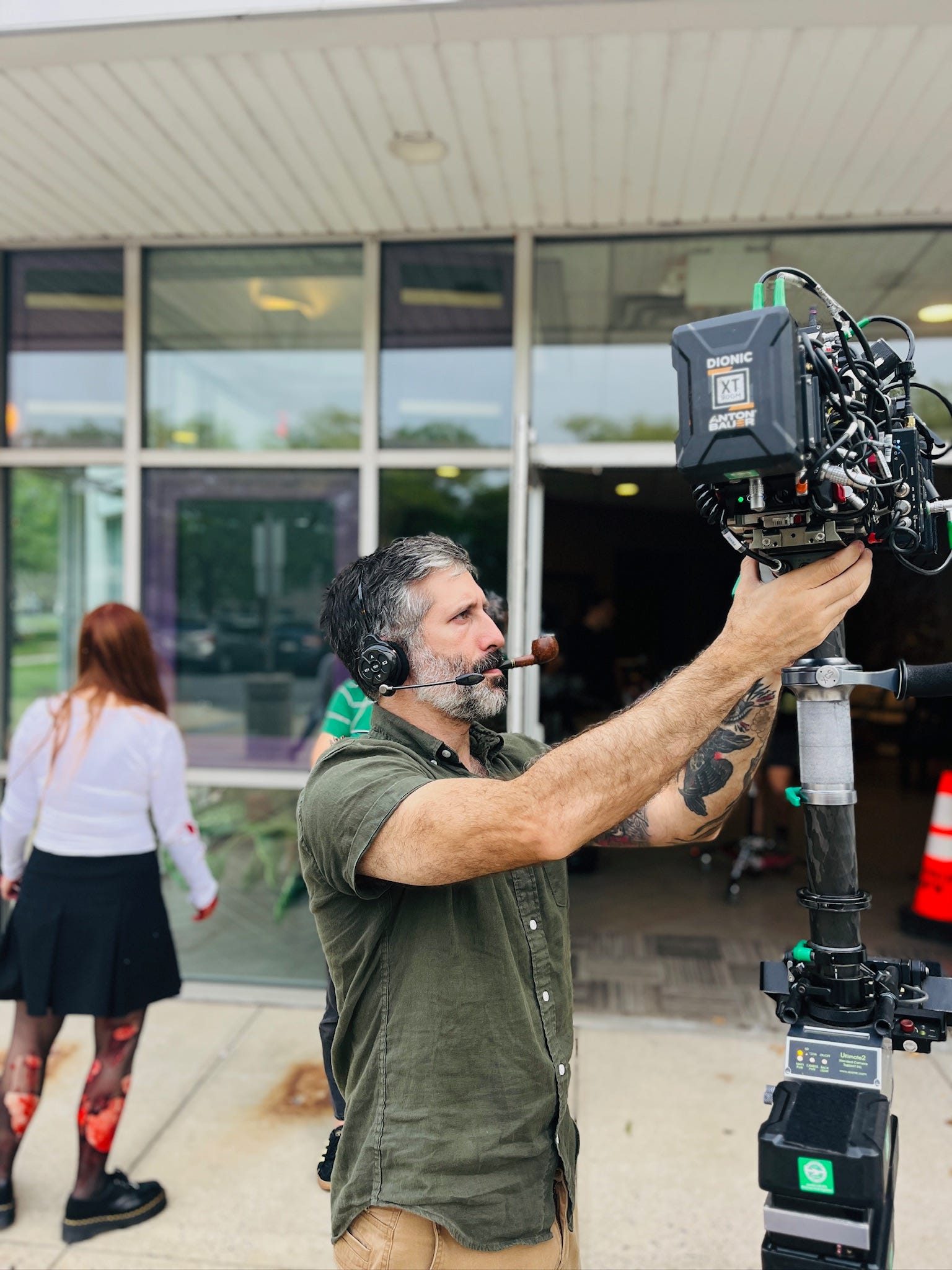
Stew Cantrell (hot husband alert) balancing his rig before we got a shot following Lacey Jeka into the theater on the set of “Guts!”
GRIP - Again, defer to your DP here. They generally have a grip that they have worked with before and prefer, and it’s great to have a team that has already worked together before to make the experience more seamless. In general, I’ve gotten by with a Key Grip, Best Boy Grip, and a swing. So your key + 2. But if your key is telling you that you need more people…hire more people OR scale back what you’re requiring for the shoot. For example, I like using a dolly quite a bit. If you’re like me, get a proper dolly grip that your DP likes working with and have that be one of their only jobs. The last thing you want is your Grip department not to feel supported. They literally hold the shoot up and together, and it’s a shit rolls down hill kind of thing.
Circle track!!! Ty Steve Forbes for making my dreams come true! On the set of Guts!
ELECTRIC - This is a little bit of the same here. Gaffer, Best Boy Electric, and your swing. Defer to your DP and get someone that they enjoy working with and trust.
A little side note with the Grip and Electric department: For the most part (not always), your Key Grip and Gaffer will have their kit and gear that they can rent out to your short film. Start those conversations early with your team to see what everyone needs and if you need to outsource any gear or rent from external companies, etc.
ART - The same as with camera and G&E, with art, defer to your Production Designer on the crew. I’ve done shorts where we literally built sets out of wood palettes and sheets (Judy Posey, you’re a genius) to just showing up and moving a few things around. That being said, listen to your PD on how many hands they need on the day. Generally, it’s the Production Designer plus two or three people.
Remember the magic of Amazon! You can buy and return so many things. So don’t panic about purchases. But be sure to set aside some real cash for the build of your world. Have an honest conversation with your art team about what you want and what they need to achieve your vision. And if they cannot achieve your vision with the budget provided, then you either need more money or you need to recalibrate your expectations. Your art team is sadly not magicians.
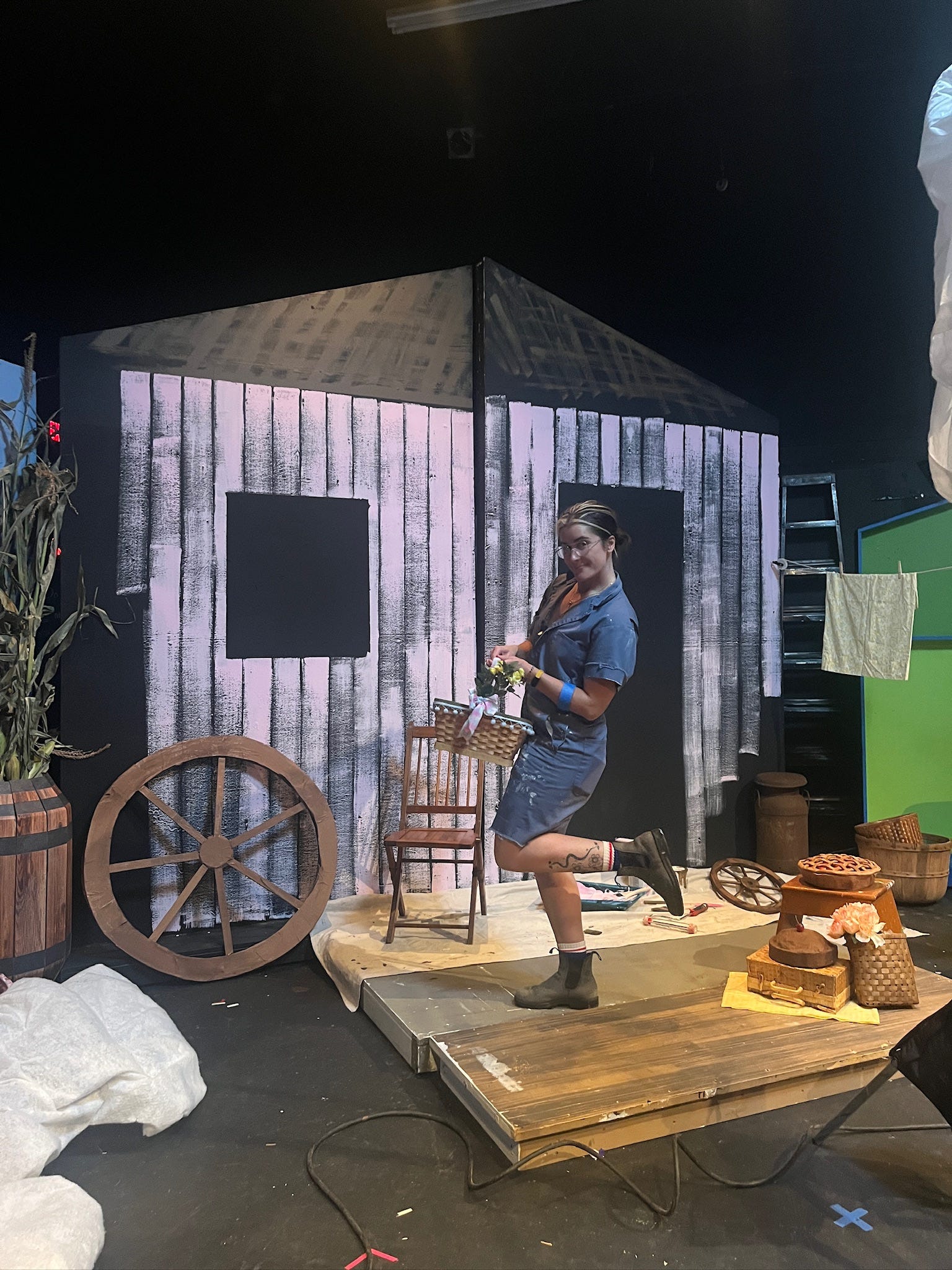
Claire Gilbertsen (maybe a magician), Production Designer of “Guts!” and all-around genius. I love you
HMU - I don’t have many notes with this one, but do hire separate hair and makeup people. I’ve made this mistake before, and more than anything, it just sours your crew. And be realistic. Do you need a makeup person, or can you actors just come camera-ready? Are you doing gore/blood? Is it complicated hair that is required to tell the story, or do you just need someone there for help with continuity? If you just need help with continuity, have a conversation with your Script Supervisor and mention that that is something you need help with. More often than not, they’ll have no problem with that.
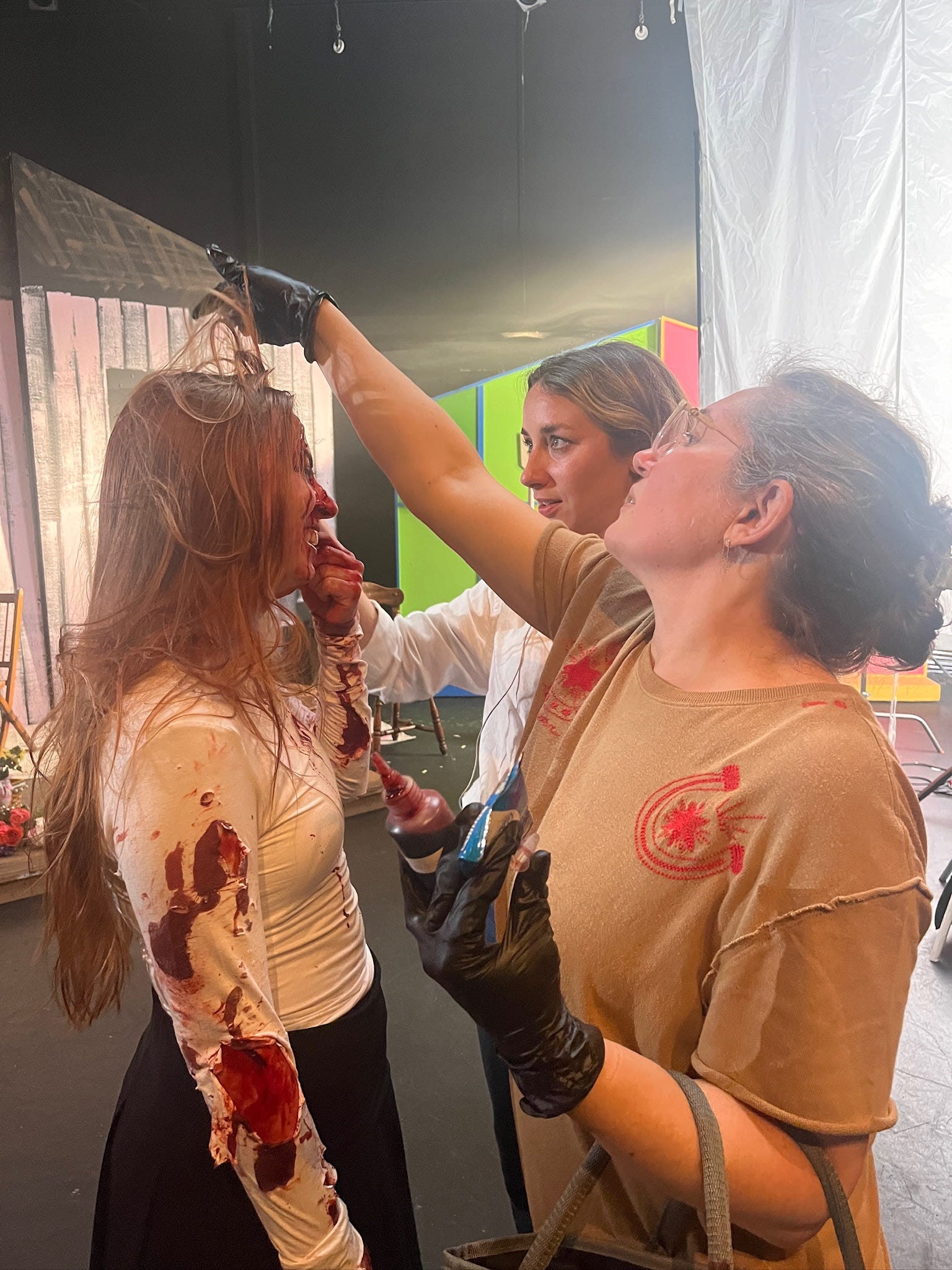
Lacey Jeka getting bloodied up on the set of “Guts!” by Christina Grant (the original scream queen… sorry Jamie Lee)
AD DEPARTMENT - DUH! Your AD, and depending on the size and scope, I’d do a 2nd AD and two PAs. And not to be a broken record, but defer to your AD on how many sets of hands they need. Also, your AD is a great resource in gauging the temperature of the rest of the crew. If you’re the director, the crew generally won’t bring their worries to you, but they will bring them to the AD. Be sure to open that line of communication, a la, “I want to know if a department doesn’t feel supported so that I can do something to help.”
PAs - a little side note here about PAs. I find that a big reason that PAs do short films is that they want to learn, and they are new to the game. Be sure you have a conversation prior and see what their goal is in this industry. Is it camera? Let them help the camera department! Do they want to direct? Let them shadow you. And so on. Being a PA is tough. Make sure that they feel seen and appreciated.
My other note is to HIRE SOMEONE WHO CAN COMFORTABLY DRIVE A BOX TRUCK. Sorry. I'm screaming. But this is so important. You’re more than likely going to need a PA to drive a 14-foot box truck with a lift gate (don’t skimp on the lift gate) to pick up camera and grip, and electric the day before your shoot. Especially if you are in NY, driving a big box truck around the city with hundreds of thousands of dollars in gear while some asshole is laying on the horn and the rental house isn’t answering the phone is STRESSFUL. I’ve done it before and wanted to DIE. Have your producer triple-check that your PA is okay with what you’re asking of them and do a detailed breakdown of the pick-up day complete with times, addresses, lunch breaks, phone numbers, appropriate COI’s for gear etc. and be sure that someone (you) is always available by phone should they run into an issue. And to PAs, if you hit something or someone hits you, don’t panic, it’s happened on every single one of my shoots. That’s what insurance is for. Let your producer know right away so that we can make sure you’re safe and taken care of.
SOUND - So let’s pretend you have three principals and some background. Your sound person is going to want to know what the maximum number of characters is in a scene, aka how many lavaliers you will need on the day. Every sound person is different, but some will not be comfortable with mixing and booming at the same time, in which case you’ll need a boom op in addition to your sound mixer. I think for the most part I’ve gotten away with having just a mixer on all of my shorts, but man, I put Jon Reyes through his paces (forgive me, Jon). And Reyes is a very experienced sound mixer.
SCRIPT SUPERVISOR - You just need the one! Easy! I LOVE my script supervisor, Nieves Perchin Garcia. The only time I did not use her was a short I did in LA, and I would have flown her out if I had the budget to do so. If you’re a director, this is an intimate relationship! I’d say go to lunch, talk movies, find out who they are creatively, and see if you both speak a similar creative language. I got lucky with Nieves. She has a wonderful eye and does her homework. On top of the “what side of the line should we be on,” continuity, and general protection of the script, you want a script supervisor who understands what kind of story you’re telling and feels empowered to speak up and give creative opinions. Some of my favorite shots are shots that Nieves has pitched. They're also the person who talks directly with your actors; make sure you’re comfortable with the person who’s doing that.
CAST - More than likely, your actors are going to be SAG. If your budget is $30K or under (which it should be for this scale), then you’ll need to do a SAG New Media contract. This means that the producer and the actor or the actor’s reps negotiate the rate internally, and SAG waives the right to mandate a certain rate. Generally, it’s $100/day, but if you’re using a name actor, you might need to be prepared to shell out a little more. For the most part, I’ve used friends in my short films, but I have had to audition before, and I really loved it, and got lucky. Make sure you get who you need and then have a cast dinner or Zoom before you start shooting! Get the vibes going so everyone feels comfy and excited.
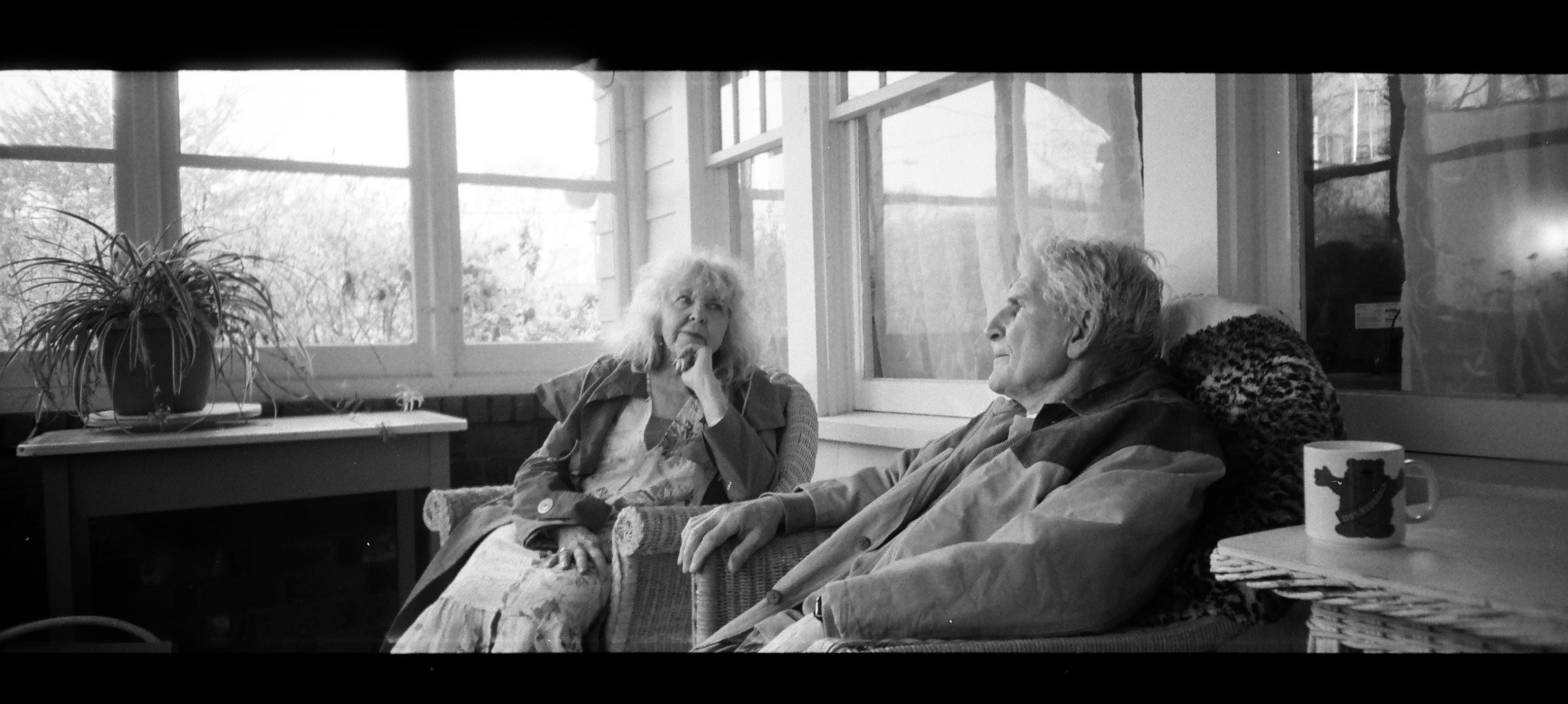
The lovely Kathyn Grody and Phil Coccoletti on the set of “Wooly Bully”
With all of these positions, if you don’t have someone that one of your team members likes to work with, and you need to hire an unknown, 100% interview and ask for references. And CALL those references. You’re going to be trapped in a stressful, fast-paced environment with this person, and you want to know what you’re dealing with.
GEAR
I covered it a little in the above, but I’ll reiterate and give some new info below.
Camera - Your DP might have a camera! In which case, yay! Make sure the two of you have an honest conversation about what they want to rent out their camera for. You might think, “If it’s their camera, why aren’t they just donating it?” GREAT question. And sometimes, they will! But DP’s generally buy gear so that they can rent it out to productions that they are on, as well as other productions. So by using their camera on your short, they are technically losing money. OR they might co-own the camera with another person, in which case the other owner needs to be compensated for that rental. If your DP doesn’t have a camera, no sweat! Tons of rental houses enjoy helping emerging filmmakers with camera rentals. I’m through and through a Panavision girl. Shout out to Marni, who has helped with everything I’ve ever directed. Marni does her best to help me out within reason. I try to use lenses that aren’t in demand (although I’ve gotten lucky) and shoot during times that aren’t as busy. Either way, you’ll need a COI. If you’re going through your DP, your COI might not need to be as rigorous as it would be with a rental house. Be sure to take a look at those requirements early on so that you can get the ball rolling.
Grip & Electric - same with G&E. Lots of Grips and Gaffers have their own trucks and like to use their own gear and rent that out to the production. All the things I said about that in camera apply here. Oftentimes, I’ll use my team’s gear and supplement with a rental house. My buddy James Murphy (the best) over at Insight Equipment has also been ride-or-die since day one for me (I’d lay on a railroad track for you, Murph) and helps me with whatever I need. Find your Murph. Call rental houses, introduce yourself, say what you need, and build relationships! You will ALSO need a COI for this gear.
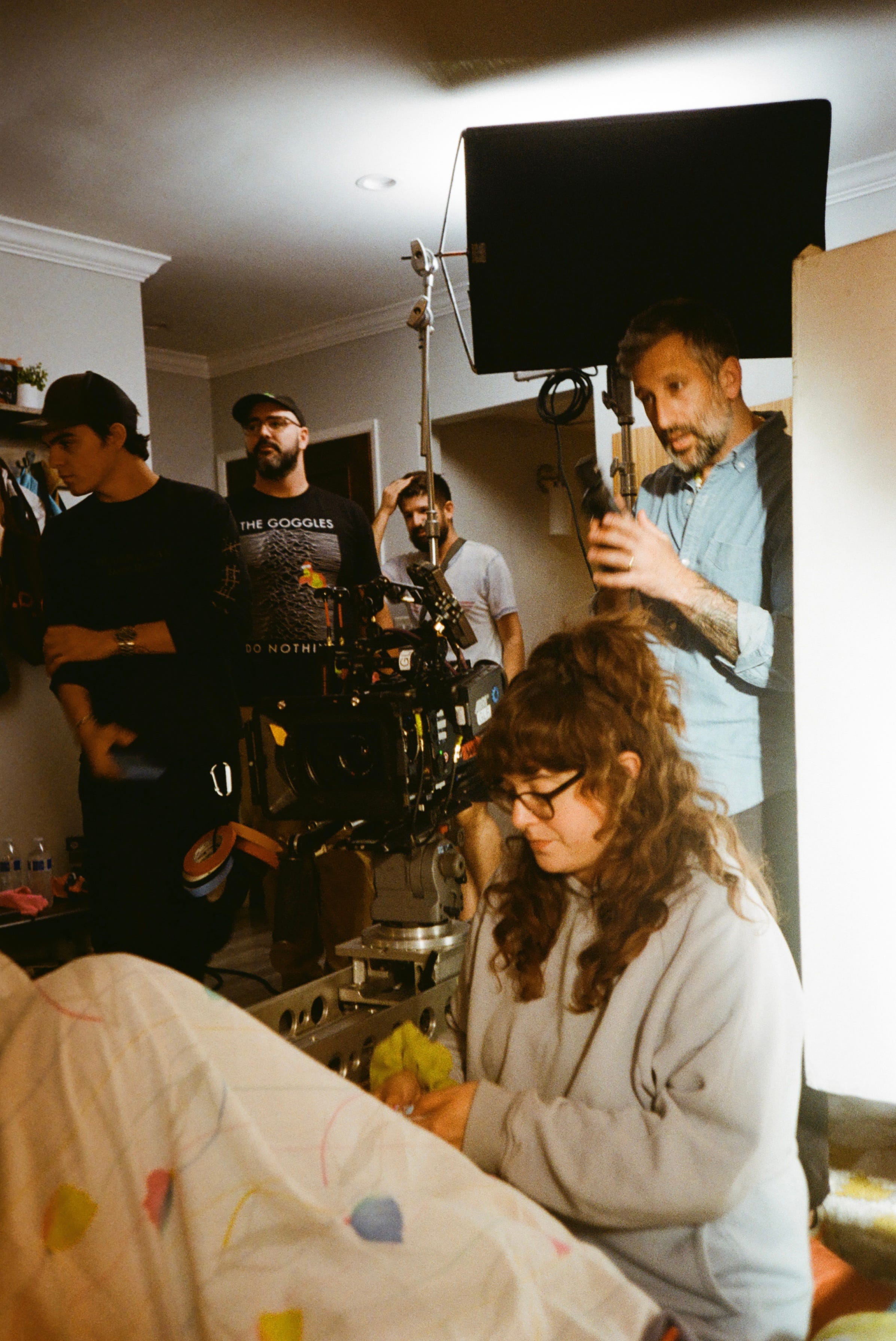
Pile of crew on the set of “Apocalypse Besties”
Extra - Camera and G&E are the big ticket gear items, but you’ll also need to pay kit rentals for Script Supervisor, Sound, HMU, Wardrobe, and Art. You’ll need a COI for sound.
Gear Note - Something I never thought about, but boy, do I check immediately now, is that in general, camera and G&E CANNOT be stored in a locked vehicle overnight. Even if it’s a secured lot. Meaning, you can’t just grab the gear, toss it in the truck, and keep it there overnight. Most rental houses require that their gear be stored in a building that locks. It’s part of their contract. Be sure that you negotiate with either your location or find a storage facility where your gear can be held until you’re ready to shoot. Also, keep in mind that if you’re shooting over a weekend, when you wrap on Sunday, gear houses will be closed, so you’ll need to have a place to store gear until Monday, when they open.
So you have your crew, your gear… how the fuck are you going to carry all of this? Excellent question. A 14ft box truck with a lift gate. Preferably from the edge (and no, I’m not sponsored by them), they are reliable and affordable. You must get a truck with a lift gate so that your camera and G&E team don’t hurt themselves loading and unloading. Art and wardrobe may also need a truck or van to transport everything. Do not make art and camera share a truck. Depending on how much gear you have, it might also not be possible for camera and G&E to share a truck. Make sure and have those conversations in advance. You will also need to issue the truck rental place a COI. Oh, and this might seem stupid, but if you’re someone who does multiple short films a year (me) and you have different LLCs for each short (as you should), be sure that the LLC on the COI matches the LLC on the rental agreement. That happened to me recently, and it almost cost me $14,000. Fun! Did I mention I still mess up constantly?
RATES
Okay, so this is a touchy subject. As it should be. A few years ago, I’d say that for the most part, people do short films for “the love of the game.” They just wanted to be involved in something fun and creatively fulfilling. But as the industry contracts, jobs become few and far between, and the bar for caliber of short films is raised, it is expected that the crew will be compensated appropriately for their time. Generally, I set aside $10K for labor, but recently I’m finding that I need more.
I won’t get into specific numbers right now, but I will release a budget breakdown down the road that does. What I will say is have your producer or you have an open and honest conversation about the financial resources you have to make what you want to make, and what the two of you can comfortably come to an agreement on. Once you’re in negotiations, make sure that you’re negotiating numbers over email and not over the phone. This gives your crew member time to consider and advocate for themselves, and it gives you a written contract on what the two of you agreed on that you can reference later should it come to that. This might sound overboard or silly, but I’ll do a short film horror story substack and tell you why I am the way I am.
The last thing I’ll recommend with rates is never let anyone do it for free. Whether they are getting paid through their kit, labor, $50 for lunch. They must get paid something. It creates accountability on their end. It’s an unspoken contract, an exchange of goods and services.
SCHEDULE
Okay! You’re crewed up, gear is locked in, and your shoot is a week away! Eeek! Your script should be in its final form (or close). Provide the fdx file to your Script Supervisor so they can do a breakdown, and to your AD as well, so they can build the final schedule. This will determine your call times and everything else. Since the crew is working generally for less than their normal rates, do your best to keep your days at 10 hours. 12 hours is fine, but in my opinion, you should never be going over 12. Make a plan with your AD and DP about what can fall away if it has to that if you find yourself in a bind, you’re not panicking about what to cut.
EXTRA
So that was a lot, and next week I’ll do a small post about last-second panic things before we dive into the physical shoot. But a few small things to think about that don’t need a ton of elaborating —
Good food! DUH - Where is the food coming from? Catering? Passing a phone around to order a Sweetgreen? What’s your crafty selection? Any crew dietary restrictions you should be worried about? DO NOT skimp on food. This is an easy way to keep the crew happy.
Charlotte Gilbert, Producer, on the set of “Guts!” showing off some solid crafty
Permits - you may be able to avoid permits, but you might not! Do your homework. I’ve stolen shots before, etc., which I think is fine, and I’m not above but make sure that your crew is aware that that is what you are doing and they are comfortable with that.
Housing - are you shooting far away or outside the zone? If it takes longer than an hour to get to set, you need to get lodging for your crew. An hour and a half both ways is too much travel after a long day. If you can’t afford lodging, you need to find a location closer to your crew.
Safety rides - If god forbid, you have a day longer than 12 hours and it’s late, make sure that your crew is good to make it home safely. If they are not, you need to provide safety rides (Uber is fine).
Union vs. Non-Union - for the most part, short films are non-union, but some of your crew may be union! Every crew’s union is different and has different tolerance levels for their members participating in non-union projects. Either way, find out your crew members’ union status and give them the option to either a) be left off the call sheet or b) be given a different name on the call sheet to protect themselves.
I also feel compelled to say that as I write all of these tips and “rules,” I’m super aware that I have broken many of these rules. So if you’re reading this and thinking “what the fuck, Buckels…” You’re right, and I’m sorry! I’m not perfect, and many of the things I talk about I’ve learned the hard way. If I’m feeling brave and vulnerable maybe I’ll have a glass of wine and really tell you all the big ways I’ve fucked up. Short films are a labor of love for sure. Things go wrong. They don’t go the way you’ve planned, and things blow up in your face. BUT they are some of the best times I’ve had in the industry so far. You’re going to mess up, and that’s totally okay. At the end of the day, do your best cause this is going to be a blast.
Love and hugs,
Buckels